Did anyone else get the impression from the readings that courtly
love makes love more confusing and frustrating than it already is? Call me
individualistic, but there’s something not quite right about spelling out
particular rules for something that is so personal and intimate and variable. No couple will have exactly the
same love as another, so why try to standardize it so completely? If this is
love, then I’m not so sure I want to get involved.
And yet, Rule 8 of Love is “No one should be deprived of love
without the very best of reasons” (Capellanus 185). Great.

Capellanus
establishes “no homo” in Chapter 2, but I bet he never thought of this! My roommate has an out!
Courtly love’s relationship with marriage also threw me off
. . . at first. Then it intrigued me. “Feudal nobility arranged marriage to
suit families’ advantages, often while the children were still infants”
(Thompson). Yet the rules of courtly love and the stories that concern them don’t
seem too concerned with honoring these marriages if love conflicts. After all,
Rule Number 1 of Love is don’t talk about—er, I mean, “Marriage is no real excuse
for not loving” (184). We see this played out too perfectly in the summary that
Dr. Diane Thompson gives of Marie de France’s Eliduc. Eliduc’s wife seems to experience no anger or pain from her
husband falling in love with another woman. To me, she seems a little too
content to become a nun while Eliduc marries his new love.
Marriages arranged for advantage, convenience, and gain have
no promise of love for the spouses-to-be. Perhaps Eliduc and his first wife
were in a loveless arranged marriage. Perhaps they really were happy to leave
each other. Perhaps tales of courtly love, and the prioritization of love over
marriage vows, provided hope and comfort to nobles in arranged marriage. Just
as many people today (myself included) enjoy stories that provide an escape,
maybe stories of courtly love provided an escape from the reality of marrying
for social climbing and political alliances rather than for love.
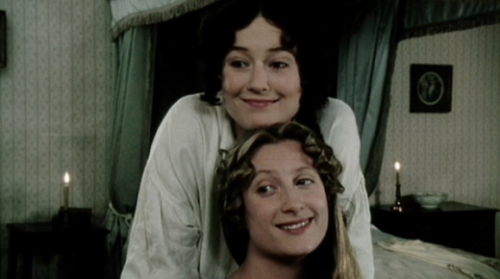
"I am determined that only the deepest love will induce me into matrimony. So, I shall end an old maid, and teach your ten children to embroider cushions and play their instruments very ill."

Wow. We've needed the comfort and daydreams a lot over the centuries, haven't we?
Capellanus, Andreas. The
Art of Courtly Love. New York: Columbia University Press, 1960.
Thompson, Diane. “Courtly Love Study Guide.” Northern
Virginia Community College.
I pledge that I have neither given nor received any
unauthorized aid on this assignment.
Miranda A. Barrientos
